 Visit MrsMakeup UK
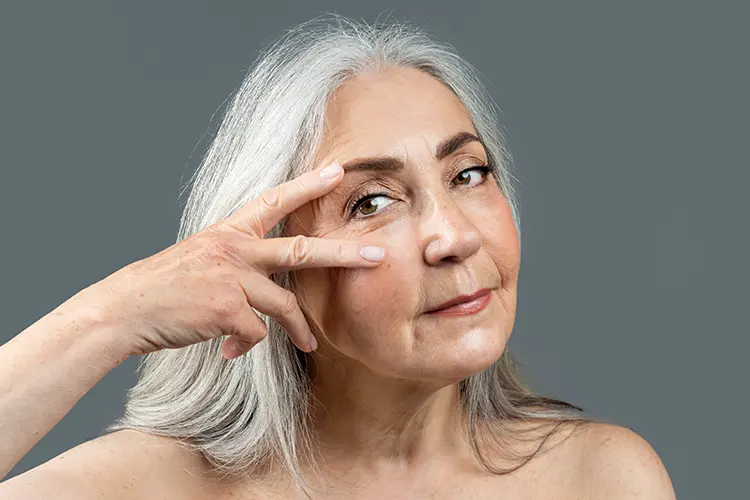
Four Clean Concealers for Mature Skin — All Available in Ireland
The skin around your eyes is the thinnest on your face — and the most exposed to the ingredients in whatever you apply to it. Most popular concealers still contain cyclosiloxanes that migrate into fine lines, alcohol denat that dries and cracks already-dry skin, and synthetic fragrance applied millimetres from the eye itself. Used daily, these aren't neutral. They accelerate exactly the ageing they're supposed to conceal.
The four picks below have passed our full ingredient review. No cyclosiloxanes, no synthetic fragrance, no high-concentration alcohol. All four are available to Irish shoppers through Amazon — and because clean formulas span the full price range, there's an option here whether budget or finish is the priority. Use the links to skip straight to any product.
Our Top Concealers for Mature Skin
- NYX Bare With Me Concealer Serum — best all-round
- e.l.f. Soft Glam Satin Concealer — best budget
- Essence Skin Lovin Sensitive Concealer — best for sensitive skin
- KIKO Love Fusion Radiant Concealer — best radiant finish
🏆 Mrs Makeup — Top Concealer Pick for Mature Skin Ireland
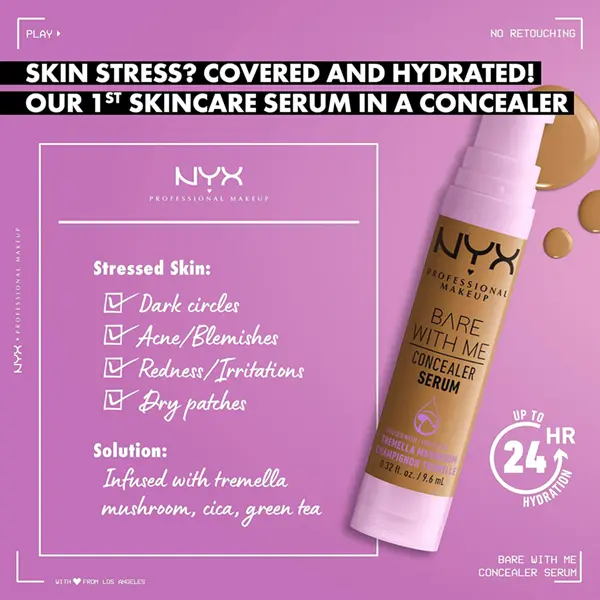
NYX Bare With Me Concealer Serum
- Snow Mushroom (Tremella Fuciformis) — holds up to 500x its weight in water; keeps the delicate under-eye skin plump and hydrated through the day
- Centella Asiatica — anti-inflammatory; supports thin skin repair and resilience with daily use
- Green Tea Extract — antioxidant protection for the eye area where skin permeability is highest
- Allantoin — soothes and softens, reduces irritation and supports the skin barrier
- Sunflower Oil & Tocopherol (Vitamin E) — nourishing oils that condition without heaviness or clogging
- Zero hard flags · Zero soft flags — passes our full ingredient review with no exceptions
- No synthetic fragrance · No alcohol denat. · No cyclosiloxanes — none of the ingredients that cause creasing, dryness or sensitivity at the eye
- Serum formula, not conventional coverage · Medium coverage, buildable · Natural finish
The highest-reviewed concealer in our database — and the one most likely to change how you think about concealer for mature skin.
Affiliate links: Some links on this page go to Amazon. If you buy through them we may earn a small commission at no extra cost to you. It never influences what we recommend — a product either passes our ingredient standard or it doesn’t.
NYX Bare With Me Concealer Serum
Before You Buy — Quick Reference
| Coverage | Medium, buildable |
| Finish | Natural — not flat, not dewy |
| Best for | Mature, dry, sensitive and combination skin |
| Think twice if | You need maximum coverage for heavy pigmentation or blemishes — layer with a higher-coverage spot concealer for those areas |
| Fragrance | No synthetic fragrance |
| Cyclosiloxanes | None |
| Alcohol denat. | None |
| Price | At time of writing — Amazon.ie |
| Vegan & cruelty-free | Yes |
| Mrs Makeup flags | 0 hard · 0 soft |
The standout pick for mature skin — and the one most likely to change how you think about concealer. The NYX Bare With Me is a serum concealer rather than a conventional coverage formula, which means it approaches the under-eye from a skincare angle first. Snow mushroom (Tremella Fuciformis), Centella Asiatica, green tea, allantoin, sunflower oil, and tocopherol. These are ingredients that support and soothe the thin skin under the eye rather than just sitting on top of it.
Medium coverage with a natural finish — enough to brighten and even out without the layer of product that creases when the eye moves. It's also the highest-reviewed concealer in our database, which matters because consumer validation on under-eye coverage tends to be honest. If it creased, people would say so.
e.l.f. Soft Glam Satin Concealer
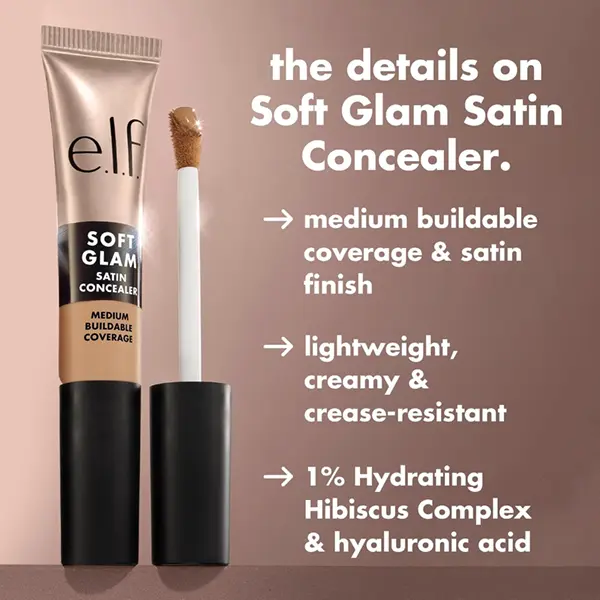
🏆 Mrs Makeup — Best Budget Concealer for Mature Skin Ireland
e.l.f. Soft Glam Satin Concealer
- Dual Hyaluronic Acid — Sodium Hyaluronate and Hydrolyzed Sodium Hyaluronate work at different skin depths; the low-molecular-weight form penetrates further for lasting hydration under the eye
- Squalane — lightweight emollient that conditions and plumps without clogging; excellent for dry and mature skin
- Panthenol (Pro-Vitamin B5) — humectant and skin-barrier support; reduces the look of dryness around the eye area
- Hibiscus Extract — natural AHA source; supports cell turnover and adds a subtle brightening effect
- Sunflower Oil & Tocopherol (Vitamin E) — antioxidant nourishment that protects and conditions the under-eye
- Zero hard flags · Zero soft flags — passes our full ingredient review with no exceptions
- No synthetic fragrance · No alcohol denat. · No cyclosiloxanes — clean from base to actives
- Full coverage · Satin finish — the satin keeps coverage from reading as flat or cakey on mature skin
An ingredient list you'd expect from something at three times the price — and it passes every part of our clean review with no flags at all.
Before You Buy — Quick Reference
| Coverage | Full, buildable |
| Finish | Satin — polished without being flat |
| Best for | Mature, dry and combination skin; anyone switching from a matte drugstore concealer |
| Think twice if | You want a very light, sheer coverage for a no-makeup look — apply sparingly and sheer it out |
| Fragrance | No synthetic fragrance |
| Cyclosiloxanes | None |
| Alcohol denat. | None |
| Price | At time of writing — Amazon.ie |
| Vegan & cruelty-free | Yes |
| Mrs Makeup flags | 0 hard · 0 soft |
The budget pick — and genuinely impressive for the price. Full coverage with a satin finish, dual hyaluronic acid (Sodium Hyaluronate and Hydrolyzed Sodium Hyaluronate), squalane, panthenol, sunflower oil, and hibiscus extract. That's an ingredient profile you'd expect from something at three times the price, and it passes every part of our clean review with no flags at all.
The satin finish is the key detail for mature skin — it provides the coverage without the matte powder-loading that dries into fine lines. If you've been relying on a drugstore full-coverage matte concealer and wondering why it creases by lunchtime, this is the direct clean alternative to try first.
Essence Skin Lovin Sensitive Concealer
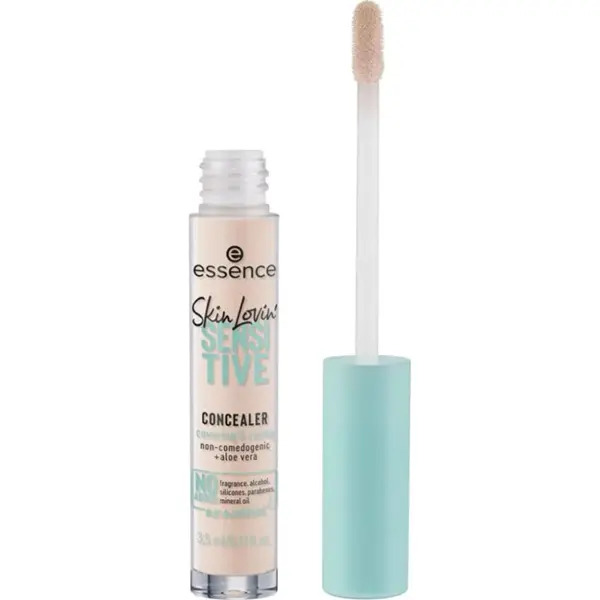
🏆 Mrs Makeup — Best Gentle Formula Concealer for Mature Skin Ireland
Essence Skin Lovin Sensitive Concealer
- Aloe Vera (Aloe Barbadensis Leaf Juice) — soothing, anti-inflammatory; calms and conditions the eye area; one of the first actives in the formula
- Stearoyl Inulin (Prebiotic) — plant-derived prebiotic that supports the skin's natural microbiome rather than disrupting it; an uncommon addition in this category
- Hydrogenated Lecithin — phospholipid that mirrors the skin's natural barrier lipids; supports and repairs the barrier rather than just sitting on top of it
- Zero hard flags · Zero soft flags — passes our full ingredient review with no exceptions
- No synthetic fragrance · No silicones · No alcohol denat. — fully clean from top to bottom
- 24 ingredients total — one of the shortest concealer ingredient lists available; fewer ingredients means fewer potential triggers for reactive skin
- Medium coverage · Natural finish — buildable without heaviness
If your skin is reactive or you've experienced sensitivity reactions to concealer before, this is the one to start with.
Before You Buy — Quick Reference
| Coverage | Medium, buildable |
| Finish | Natural |
| Best for | Reactive, sensitive and mature skin; anyone who has experienced stinging or irritation around the eye |
| Think twice if | Your under-eye is very dry — the hydration profile is lighter than the NYX or e.l.f. options; layer over a good eye cream and give it time to absorb |
| Fragrance | No synthetic fragrance |
| Cyclosiloxanes | None — fully silicone-free |
| Alcohol denat. | None |
| Price | At time of writing — Amazon.ie |
| Vegan & cruelty-free | Yes |
| Mrs Makeup flags | 0 hard · 0 soft |
The cleanest formula on the list by ingredient count — 24 ingredients total, which in the concealer category is remarkably minimal. Fragrance-free, silicone-free, no alcohol — and it pairs aloe vera with stearoyl inulin (a prebiotic that supports the skin's natural microbiome) and hydrogenated lecithin, a phospholipid that mirrors the skin's barrier lipids. At its price point it's one of the most affordable clean concealers available in Ireland.
If your skin is reactive or you've experienced sensitivity reactions to concealer before — redness, itching, stinging around the eye — this is the one to start with. The short ingredient list means fewer potential triggers, and the prebiotic inulin is an interesting addition that supports the skin's natural microbiome rather than disrupting it.
KIKO Love Fusion Radiant Concealer
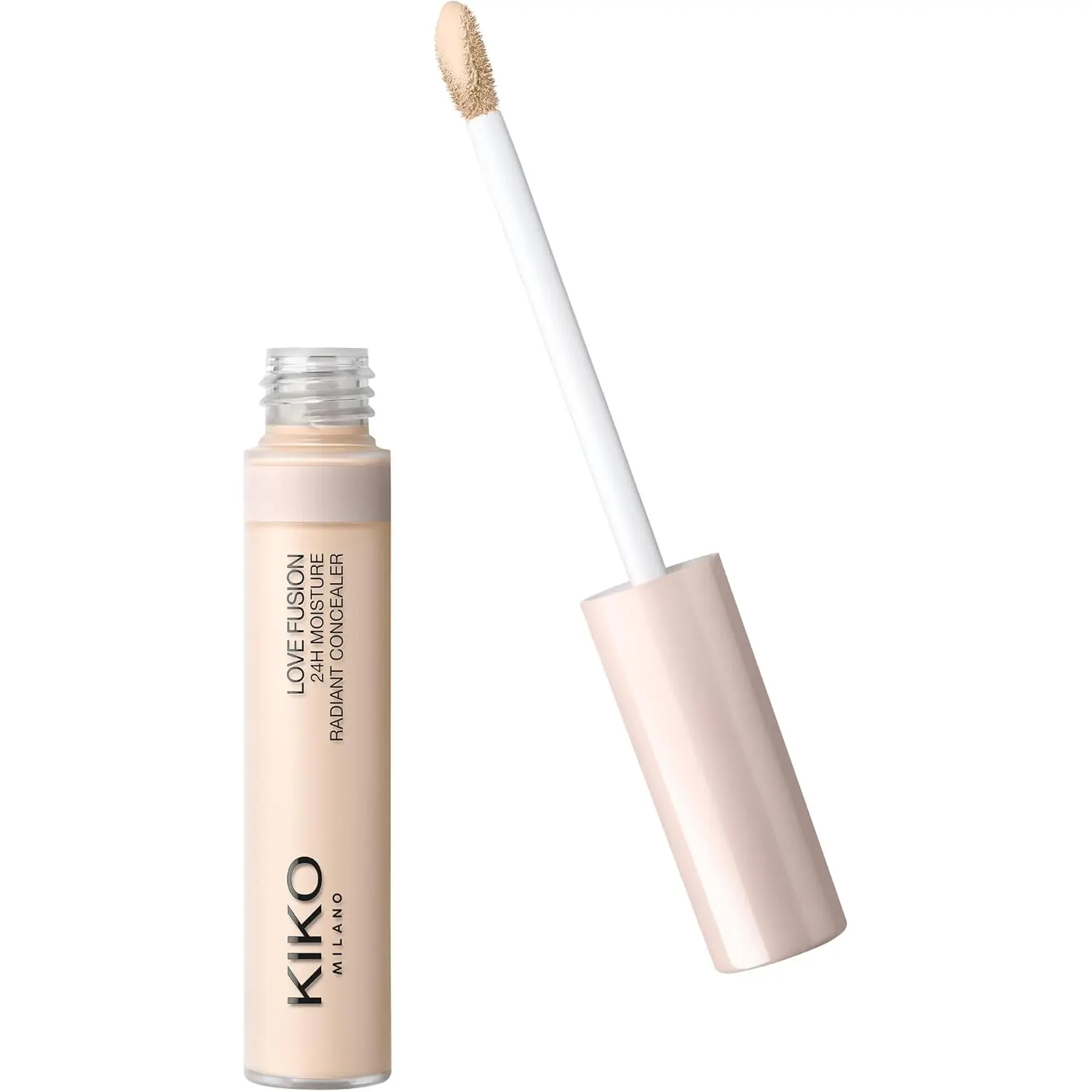
🏆 Mrs Makeup — Best Radiant Finish Concealer for Mature Skin Ireland
KIKO Love Fusion Radiant Concealer
- Sodium Hyaluronate — draws and holds moisture in the under-eye area; contributes to the plump, rested appearance the formula delivers
- Sorbitol — humectant that locks hydration in without heaviness; supports the radiant finish staying fresh through the day
- Argan Oil (Argania Spinosa Kernel Oil) — conditioning oil rich in fatty acids and tocopherols; nourishes without clogging
- Caffeine — recognised for its depuffing and brightening effect on the under-eye area; a targeted active for tired-looking eyes
- Rosa Canina Fruit Oil (Rosehip) — naturally high in linoleic acid and beta-carotene; supports skin renewal and adds a nourishing antioxidant layer
- Ascorbyl Palmitate (Vitamin C) — fat-soluble Vitamin C derivative; stable in formulation; adds antioxidant protection and supports brightening at the under-eye
- Zero hard flags · Zero soft flags — passes our full ingredient review with no exceptions
- No synthetic fragrance · No alcohol denat. · No cyclosiloxanes — clean through and through
- Medium coverage · Radiant finish — works with the skin's natural luminosity rather than flattening it
The finish is the story here — if most concealers make you look more tired rather than less, this is the one to try.
Before You Buy — Quick Reference
| Coverage | Medium, buildable |
| Finish | Radiant — brightening and luminous without looking glittery |
| Best for | Mature skin that looks dull or sunken; anyone finding concealers make them look more tired rather than less |
| Think twice if | Your skin is oily or very combination — radiant finish can amplify shine on oilier skin types |
| Fragrance | No synthetic fragrance |
| Cyclosiloxanes | None |
| Alcohol denat. | None |
| Price | At time of writing — Amazon.co.uk (ships to Ireland) |
| Where to buy | Amazon.co.uk — full shade range, ships to Ireland |
| Mrs Makeup flags | 0 hard · 0 soft |
The radiant finish option — and the one to reach for if you want your under-eye area to look genuinely bright rather than just covered. The KIKO Love Fusion contains sodium hyaluronate, sorbitol, and argan oil for hydration and conditioning, with caffeine for the under-eye depuffing and brightening effect, rosehip oil (Rosa Canina Fruit Oil) for nourishment and skin renewal, and ascorbyl palmitate — a stable fat-soluble Vitamin C — adding antioxidant protection and a subtle brightening contribution.
Radiant finish concealers suit mature skin particularly well because they work with the skin's natural luminosity rather than flattening it. A matte concealer under the eye reads as cakey on mature skin; a radiant formula reads as rested. If you find most concealers make you look more tired rather than less, the finish is often the issue rather than the shade.
Concealer Tips for Mature Skin
Less product is almost always better under the eye on mature skin. Full-coverage concealers applied heavily give more product than the thin under-eye skin can hold — excess product has nowhere to go except into fine lines when the eye moves. Apply sparingly, pat rather than drag, and build only where you actually need more coverage rather than applying a uniform layer across the whole area.
Eye cream first, always — but give it five minutes to absorb before concealer. Concealer applied over damp eye cream slides and creases faster than over fully absorbed skincare. The five-minute wait makes a measurable difference to how long concealer holds.
Setting powder under the eye needs to be minimal or skipped entirely on mature skin. The powder that sets concealer in place also dries the skin and emphasises fine lines. In Irish conditions the ambient humidity usually provides enough stability without the drying effect of heavy powder setting. If you want some hold, a very light dusting of finely-milled translucent powder is enough — not baking.
Concealer Ingredients to Avoid on Mature Skin
The under-eye area amplifies every ingredient problem. Thin skin, constant movement, and proximity to the eye itself make it the most unforgiving zone on the face for a formula that isn't right.
Not sure which products to trust?
Our Beauty Assistant checks ingredients, flags problem formulas, and finds clean alternatives — just ask.
Frequently Asked Questions
For mature skin the NYX Bare With Me Concealer Serum is our top pick — medium coverage, natural finish, serum formula with skincare actives that support the thin under-eye skin rather than just covering it. If budget is the priority, the e.l.f. Soft Glam Satin is exceptional value and passes our full clean review with no flags. For reactive or sensitive skin, the Essence Skin Lovin is the safest starting point — 24 ingredients, no fragrance, no silicones.
The most reliable fix is changing the formula. Check your current concealer for cyclosiloxanes — cyclopentasiloxane and cyclotetrasiloxane are the most common — these are almost always the primary cause of creasing. Switching to a clean cyclosiloxane-free formula eliminates the problem in most cases. Beyond that: use less product, let eye cream absorb fully before applying, and skip heavy setting powder under the eye.
Medium coverage is the sweet spot for most mature skin under the eye. Full coverage requires more product to achieve its coverage level, and more product on thin under-eye skin means more available to settle into creases. For blemishes or spot concealing elsewhere on the face, a higher coverage formula applied precisely is fine — the issue is specifically with heavy application across the entire under-eye area.
Yes — a concealer that is too light creates harsh contrast, a formula that creases draws attention to the area, and a matte heavy formula emphasises texture. For blue-grey under-eye darkness the most effective approach is a peach or salmon colour corrector first to neutralise the discolouration, then a light layer of clean radiant-finish concealer over the top. Less total product, better result.
For the under-eye specifically, minimal or no setting powder is better on mature skin. Setting powder dries down the skin alongside the concealer and emphasises fine lines. In Ireland's mild, damp climate, ambient humidity usually provides enough stability without heavy powder setting. If you want some hold, a very light dusting of finely-milled translucent powder is sufficient — not baking, not a full powder application.
Complete your mature skin routine
- Foundation for mature skin — clean picks that won't settle into lines
- Primer for mature skin — the right base makes everything perform better
- Clean makeup Ireland — how our ingredient standard works
- Makeup for sensitive skin Ireland — fragrance-free picks across all categories